
Knights & Kings: A Puzzle Within a Puzzle
Some ideas take far longer to bear fruit than the initial spark might suggest. The story of Knights & Kings is exactly that kind of journey.
In early 2006, while working at the time, I came across a puzzle in a science and technology magazine that caught my attention. The puzzle revolved around chess pieces — and for me, it was more than just a brain teaser. It intersected naturally with my deep interest in chess at the time. Drawing on both perspectives, I designed an original puzzle set not on the familiar 8×8 board, but on a constrained 5×5 grid, with a single objective: swap the positions of all knights and kings between the two sides. The idea took shape within just a few weeks.
When I shared the puzzle with people around me, the reactions were telling. The problem itself was conceptually clear, but the path to a solution was anything but. Tracking dozens of moves on paper pushed most people past their patience threshold. The AI tools that can solve this kind of problem effortlessly today were not even imaginable back then. Nobody around me could spot that subtle key insight, and those who tried through the obvious approaches quickly ran out of patience. There was a genuinely good problem — but no accessible way to reach it.
The idea of bridging that gap came together quickly. That same year, I built a fully interactive interface using Delphi, turning the puzzle into a proper game. A platform where you could follow every move visually, undo and retry, save your progress and reload it. The puzzle was no longer just an idea — it had become an interactive, replayable experience that rewarded patience.
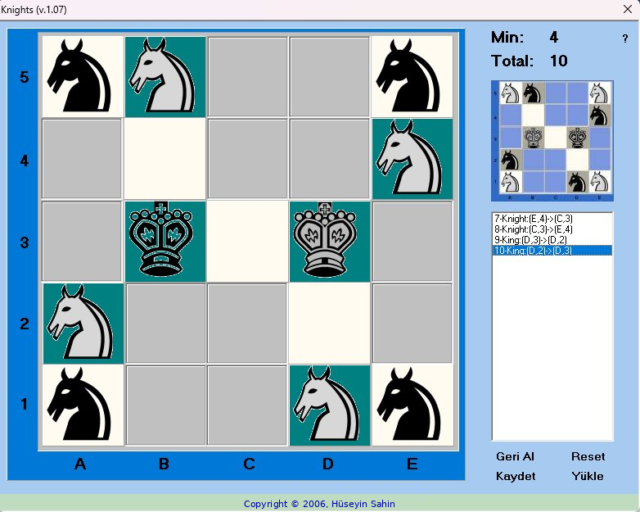
Twenty years on, in sharing this project again, I wanted to pass along a small secret hidden inside the puzzle itself.
Some problems resist being solved through the first approach that comes to mind. The solution sits there, waiting — but it only becomes visible once you let go of the familiar frame. Knights & Kings is exactly that kind of puzzle. It feels difficult not because it is inherently hard, but because seeing how elegantly simple it really is requires stepping back first. I have encountered this same dynamic many times in engineering and professional life: the biggest breakthroughs rarely come from new information alone — they come from setting aside the first instinct and looking again.
That is ultimately why we wanted to share Knights & Kings with you. Rebuilt with modern web technologies, this small puzzle is now playable in your browser, with drag-and-drop interaction and a competitive leaderboard. We hope you enjoy it — and perhaps, from time to time, it will serve as a small reminder to ask: are we looking at the problem from the right angle?
Good luck — and good moves.